---
title: "ADA: Proqio´s AI Assistant"
description: Learn how to use ADA, Proqio’s AI assistant. Ask questions in natural language, analyze project data, validate alerts, identify trends, and gain actionable insights instantly.
---
[Skip to content](https://help.proqio.com/ada-proqio-ai-assistant#main-content)
[](https://help.proqio.com/?hsLang=en)
Open main navigation
Close main navigation
How can we help you?
- There are no suggestions because the search field is empty.
1. [Knowledge base](https://help.proqio.com/?hsLang=en)
2. [ADA](https://help.proqio.com/ada?hsLang=en)
# ADA: Proqio´s AI Assistant
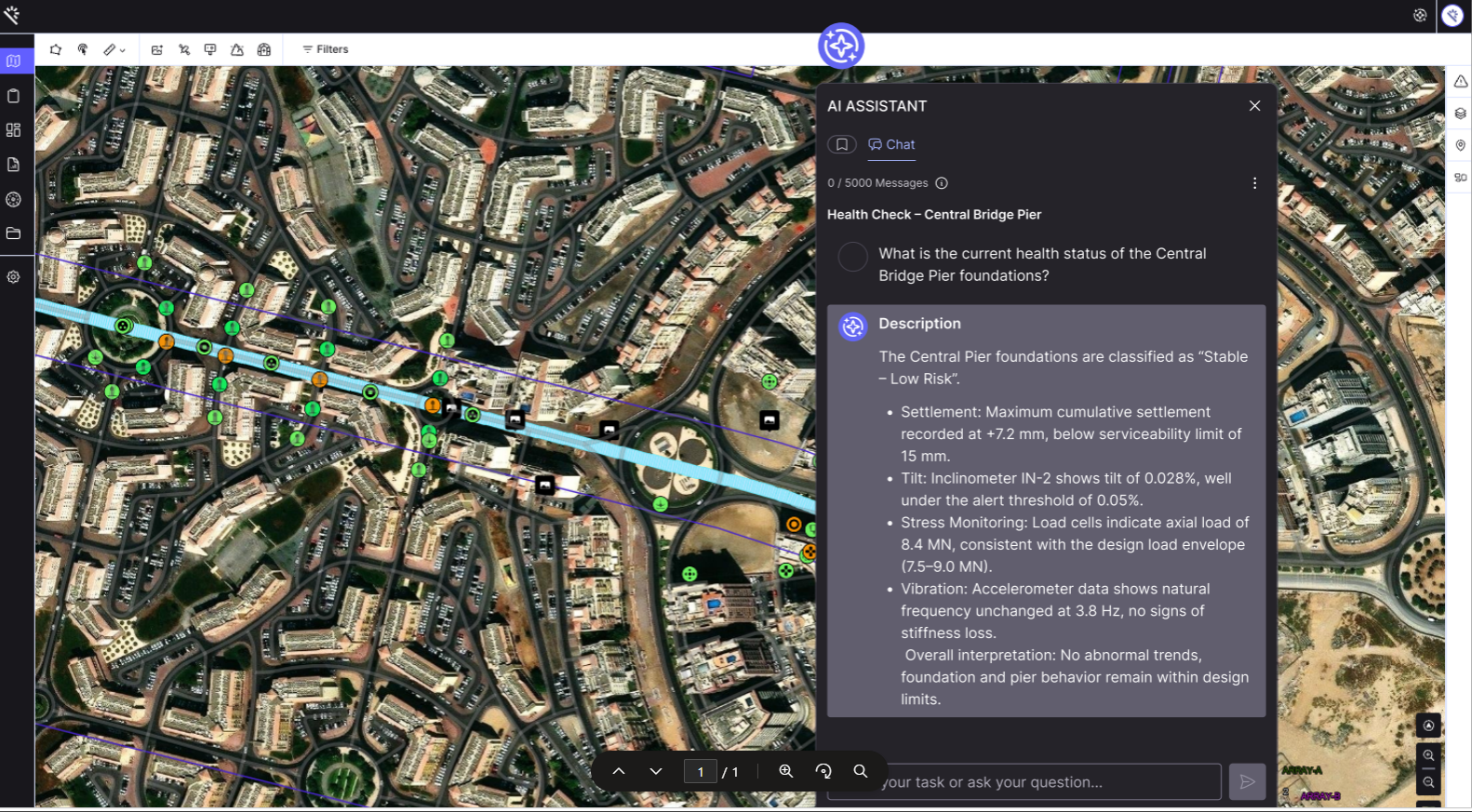
## Ada is Proqio’s AI-powered assistant that allows users to interact with their monitoring projects using natural language. By analyzing real-time data, historical records, alerts, and project information, Ada provides instant answers, insights, and summaries to help users better understand project conditions and make informed decisions.
### Why is this functionality useful?
Monitoring projects often generate large volumes of data from multiple sources. While access to data is rarely a challenge, interpreting that information and understanding its implications can be time-consuming. Ada helps bridge this gap by providing immediate answers and insights without requiring manual analysis.
With Ada, users can:
- Ask questions using natural language instead of navigating multiple tools and dashboards.
- Quickly understand what is happening across a project and why.
- Validate alerts and monitoring results with additional context.
- Identify trends, relationships, and anomalies in project data.
- Generate summaries and reports more efficiently.
- Support faster and more confident decision-making.
### 
---
### Feature Highlights
#### Natural Language Interaction
Users can communicate with Ada as they would with a colleague by asking questions about project data, monitoring results, alerts, or asset conditions. Ada interprets the request and returns a structured response based on available project information.
#### Access to Project Knowledge
Ada connects directly to the Proqio environment and can analyze:
- Real-time monitoring data
- Historical records
- Alerts and notifications
- Project documentation
- Models and related project information
#### Contextual Insights
Rather than presenting raw data, Ada provides contextual explanations that help users understand:
- What is happening
- Why it may be occurring
- How conditions are evolving over time
- What factors may be influencing observed behaviour
#### Support for Proactive Decision-Making
Ada helps users move beyond reactive monitoring by identifying patterns, detecting anomalies, and correlating variables across different data sources, enabling earlier identification of potential issues.
Please note that ADA is an additional Proqio module, and therefore is **not included** in the standard platform subscription. Activating and implementing ADA in your project will imply an **additional fee.**
---
### Types of Insights Available
Ada can assist with several types of project analysis and intelligence.
#### Correlation Analysis
Identify relationships between different monitoring variables to better understand potential cause-and-effect behaviours across a project.
#### Validation and Alert Review
Review monitoring results and alerts, helping users assess whether an alert represents a genuine issue or a potential false positive.
#### Forecasting
Analyze trends and project data to anticipate how key parameters may evolve in the future.
#### Automated Summaries
Generate summaries, reports, and alert overviews automatically, reducing the time spent compiling information manually.
#### Asset Health Assessment
Provide a consolidated view of the condition and performance of monitored structures and assets.
---
### How Does It Work?
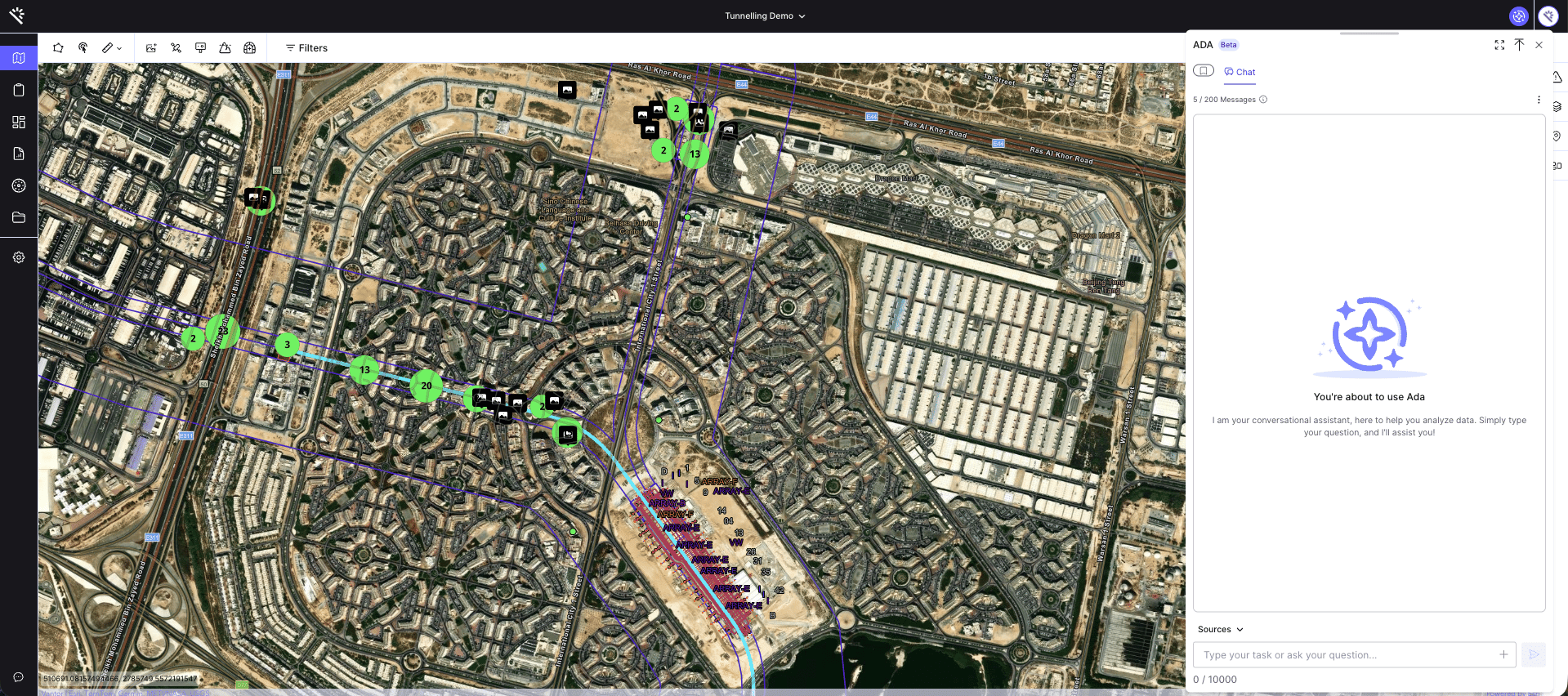
#### Step 1: Open Ada
Navigate to the Ada AI Assistant within your Proqio environment.
#### Step 2: Ask a Question
Enter your question using natural language. Examples include:
- Which instruments have generated alerts in the last 24 hours?
- What trends are visible for settlement monitoring in Zone A?
- Are there any correlations between rainfall and piezometer readings?
- Summarize the current health status of the monitored asset.
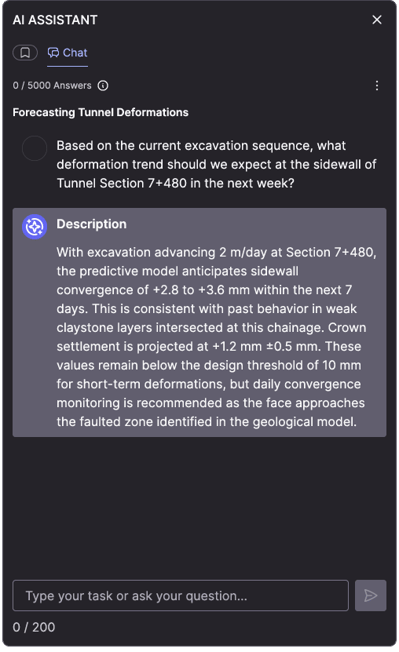
#### Step 3: Review the Response
Ada analyzes relevant project information and provides a structured answer based on the available data and context. Responses may include observations, trends, correlations, summaries, or alert validation insights.
#### Step 4: Continue the Conversation
Users can ask follow-up questions to investigate findings further, request additional analysis, or obtain more detailed explanations.
---
### Key Benefits
- Immediate access to project knowledge through natural language interaction.
- Reduced time spent manually reviewing data and reports.
- Improved understanding of monitoring results and project conditions.
- Earlier identification of risks through pattern recognition and contextual analysis.
- Faster, more informed decision-making.
- Integration with real-time and historical project information
- [Getting started](https://help.proqio.com/getting-started?hsLang=en#main-content)
- [Project details](https://help.proqio.com/getting-started?hsLang=en#project-details)
- [Teams and members](https://help.proqio.com/getting-started?hsLang=en#teams-and-members)
- [Account](https://help.proqio.com/getting-started?hsLang=en#account)
- [Configure Your Instruments](https://help.proqio.com/getting-started?hsLang=en#configure-your-instruments)
- [Notifications](https://help.proqio.com/getting-started?hsLang=en#notifications)
- [Connectivity methods](https://help.proqio.com/getting-started?hsLang=en#connectivity-methods)
- [Alerts](https://help.proqio.com/getting-started?hsLang=en#alerts)
- [Map](https://help.proqio.com/map?hsLang=en#main-content)
- [Tools](https://help.proqio.com/map?hsLang=en#tools)
- [Analysis](https://help.proqio.com/map?hsLang=en#analysis)
- [Monitoring](https://help.proqio.com/monitoring?hsLang=en#main-content)
- [Instruments](https://help.proqio.com/monitoring?hsLang=en#instruments)
- [Dashboard Creation & Configuration](https://help.proqio.com/dashboard-creation-configuration?hsLang=en)
- [Report Creation](https://help.proqio.com/report-creation?hsLang=en)
- [New Feature Releases](https://help.proqio.com/new-feature-releases?hsLang=en)
- [Project Hierarchy](https://help.proqio.com/project-hierarchy?hsLang=en)
- [Analyse and Interpret your Data](https://help.proqio.com/analyse-and-interpret-your-data?hsLang=en)
- [Learn How to Navigate Proqio](https://help.proqio.com/learn-how-to-navigate-proqio?hsLang=en)
- [Configure Your Map View](https://help.proqio.com/configure-your-map-view?hsLang=en)
- [How to Add a Real Time Picture on Map](https://help.proqio.com/how-to-add-a-real-time-picture-on-map?hsLang=en)
- [Managing Your Data](https://help.proqio.com/managing-your-data?hsLang=en)
- [Uploading Records Manually](https://help.proqio.com/uploading-records-manually?hsLang=en#main-content)
- [Steps for uploading instrument data records manually](https://help.proqio.com/uploading-records-manually?hsLang=en#steps-for-uploading-instrument-data-records-manually)
- [ADA](https://help.proqio.com/ada?hsLang=en)
- [Digital Twin](https://help.proqio.com/digital-twin?hsLang=en)
- [Lines and Textures](https://help.proqio.com/lines-and-textures?hsLang=en)
[](http://www.proqio.com?hsLang=en)
Copyright © 2026, Proqio